These are goal setting books for a company, not for self-improvement: the problem here is four people meaning the same thing by one sentence in month three, which is a different problem from personal ambition. If you read one, read Beyond Budgeting by Jeremy Hope and Robin Fraser, because most goal trouble in a small company turns out to be a budget argument wearing different words. Four of the eight below are about how companies set goals, and four argue that they should not do it that way.
How we picked these eight
We judged all eight on four criteria: the book has to be about a group rather than an individual, hold an opinion about how long a goal should last, say what happens when the number is missed, and know that sixty years of research on this exists. The third one removes most of the shelf, because setting goals is the easy half and almost nobody writes about the conversation in week eleven.
It is about a group agreeing, not one person trying harder
The hard part of a company goal is that four people have to mean the same thing by it in month three. Books about personal ambition solve a different problem, and we left them off on purpose.
It has an opinion about how long a goal should last
A year, a quarter, twelve weeks. A book with no view on the period has no view on goals, because almost every failure people describe is really a mismatch between the horizon and the work.
It says what happens when the number is missed
That is where goal systems actually break: not in the setting, in the conversation eleven weeks later. Four of the eight below are on this list mainly because they answer it.
It knows the research exists
Goal setting is one of the most studied subjects in management, with sixty years of experiments behind it. A book that ignores all of it is repeating folklore in a confident voice.
Four about how a company sets goals
These four are in publication order on purpose, because together they tell one story: management by objectives arrives in 1954, measurement gets a structure in 1996, the annual target gets attacked in 2003, and the planning period gets cut to twelve weeks in 2013. Read in that sequence, each one is a reaction to what the previous one caused.
Peter Drucker · 1954 · where company goal setting was invented
The Practice of Management is where company goal setting was invented, and reading the original explains a failure every company still repeats. Drucker introduced management by objectives here: run a business by agreeing on results rather than supervising activity, and derive each manager’s goals from what the business as a whole needs. The warning is in the same chapters as the idea. He says plainly that objectives become a control device the moment they are handed down instead of agreed, which is precisely what happened to the method almost everywhere it was adopted.
Read it if you want to know why your goal process has the shape it does, because almost every framework since is a variation on this chapter. Skip it if you want a procedure: it is a management treatise from 1954, goals are one part of it, and the examples are General Motors and Sears.
Robert Kaplan and David Norton · 1996 · leading and lagging measures
The Balanced Scorecard is the source of the distinction every modern goal framework borrows without crediting: some numbers report on decisions already made, and some predict the ones coming. Kaplan and Norton argue that financial measures are all of the first kind, so a company needs measures in three other areas chosen because they cause the financial results later: customer, internal process, and learning and growth. The idea is sound at any size. The apparatus around it is not.
Read it if your goals are all revenue and margin and something feels missing. Skip most of the machinery under about twenty people: four perspectives and a strategy map are more than a small company can maintain, and the part worth keeping is a single question, which of our numbers is a report and which is a prediction.
Jeremy Hope and Robin Fraser · 2003 · the least known and most useful
Beyond Budgeting is the least known book here and the most useful if your goals are really a budget with ambitions attached. Hope and Fraser trace the behavior everybody complains about back to one cause: a fixed target negotiated once a year. Sandbagging the number, spending what is left in December, and defending a plan that stopped matching reality in March are not character failures, they are the rational response to being measured against a promise made eleven months ago. Their alternative is relative and rolling, with targets set against a moving benchmark.
Read it if your planning year ends in an argument about numbers agreed before anybody knew what the year held. Skip the case studies, which are large European corporations with finance departments: the argument transfers to twelve people, the implementations do not.
Brian Moran and Michael Lennington · 2013 · the fastest change to make
The 12 Week Year is the simplest change on this list and the one most likely to alter something next month: stop using the year as the planning period. The claim is that a twelve month goal produces eleven months of comfort and one month of panic, and that a twelve week cycle with a weekly score removes the place procrastination lives. The mechanics are deliberately light, a small number of goals, the weekly actions that serve them, and a percentage scored every week, which is roughly what a good quarterly rhythm already does.
Read it if your annual goals are alive in January and forgotten by May, which is the single most common pattern we hear. Skip it if the self-help register puts you off: it is written for the individual first and the team second, so you translate as you read, though the translation is easy and mostly means saying “we” instead of “I”.
Four that argue with the first four
These four disagree, and we put them on the same page deliberately. Two argue that paying for a target ruins the target, one shows what actually keeps people moving on hard work, and one says the cascade at the center of most goal systems does not do what it claims. If a reading list about goals contains no objections to goals, it is a brochure.
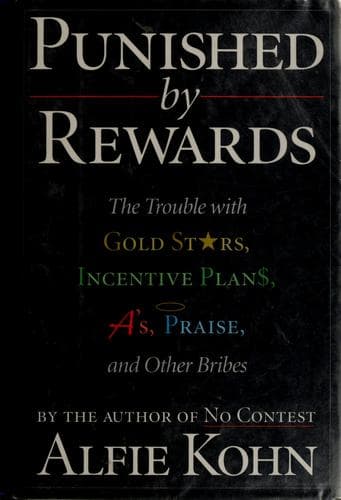
Alfie Kohn · 1993 · the case against paying for outcomes
Punished by Rewards is the strongest case ever made against attaching money to a goal, and it will irritate you if you run a bonus scheme. Kohn’s argument is that rewards and punishments are the same mechanism pointed in opposite directions: both buy temporary compliance, and both reduce interest in the work itself. The part that matters most for goal setting is narrower and harder to dismiss: when the number decides someone’s pay, it stops being an honest estimate and becomes a negotiation, which destroys the one thing a goal is for.
Read it before you attach a bonus to a target, not after. Skip it if you want balance: it is a polemic, it knows it is a polemic, and the counter-arguments are left entirely to the reader.
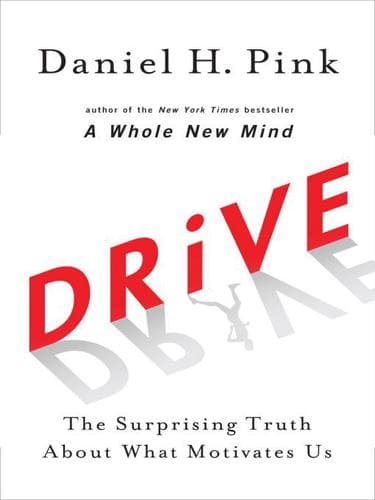
Daniel Pink · 2009 · the version your team will actually finish
Drive is the readable version of the argument Kohn made sixteen years earlier, and the one a whole team will actually finish in a week. Pink’s summary is that if-then rewards work well for narrow mechanical tasks and measurably degrade performance on anything needing judgment, and that what sustains effort instead is autonomy, mastery and purpose. For goal setting the implication is specific rather than inspirational: a goal can be demanding and public, but the moment its number is wired to somebody’s pay, you have stopped measuring and started bargaining.
Read it if you want the case in one evening, or if you need something the whole team can read before a planning session. Skip it if you already know the underlying studies: it is a synthesis rather than new research, and it says so itself.
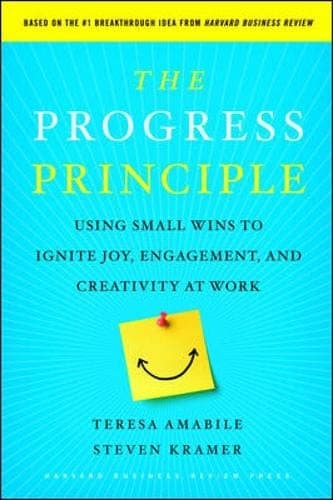
Teresa Amabile and Steven Kramer · 2011 · the best evidence here
The Progress Principle carries the best evidence on this page, and it comes from a data set nobody else here has: roughly 12,000 daily diary entries from 238 people across 26 project teams in seven companies. The finding that names the book is that the strongest driver of a good working day is making progress on work that matters, ahead of recognition, incentives, or even clarity about the goal. The mirror image is the useful half: setbacks hurt inner work life two to three times more than equivalent progress helps it.
Read it if you want to know what to do in the weeks between setting a goal and scoring it, which is exactly where goals quietly die. Skip it if you want instructions: it is a research book that reports findings and leaves you to draw the practices, and the practices are not obvious.
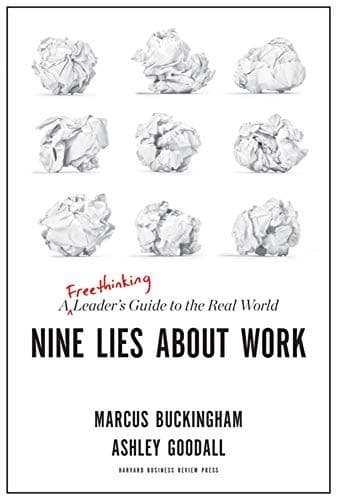
Marcus Buckingham and Ashley Goodall · 2019 · read it for one chapter
Nine Lies About Work earns its place for one chapter, and that chapter argues the thing most goal software exists to do is a lie. Buckingham and Goodall take on cascading directly: the belief that goals set at the top and pushed downward create alignment, when what they usually create is a translation exercise in which each level rewrites the level above into something it can be measured on, and the original intent survives about two floors. Their alternative is shared meaning rather than shared targets.
Read the first chapter before you build a cascade, because the objection is real and cheaper to answer now than in month six. Skip the rest if time is short, and treat the whole book as argument rather than finding: it is confident, and the evidence behind individual chapters varies a lot.
If you would rather be taught than read, this ground is lesson 7 of 17 in From Zero to Goals: The cut: not everything is priority one. Choose three goals out of seven candidates, and defend what you dropped. You make the calls inside one realistic company, run the exercise on your own goals, and the course ends with a 15 question exam (12 to pass) and a certificate worth putting on your profile.
The research itself, and the books we reviewed elsewhere
The research underneath all of this is A Theory of Goal Setting and Task Performance by Edwin Locke and Gary Latham, from 1990, which established what most of the popular books paraphrase: specific and difficult goals produce better performance than vague encouragement, as long as the person is committed and gets feedback. Our honest recommendation is not to buy it. It is an academic monograph, expensive and hard to find, and the same authors published a summary of the whole program in 2002, in American Psychologist, under the title “Building a practically useful theory of goal setting and task motivation: a 35-year odyssey”. It is about a dozen pages, it is free to read, and it is the better use of an hour.
One practical companion is worth naming even though we could not host a cover for it: Bjarte Bogsnes wrote Implementing Beyond Budgeting as the practitioner follow-up to Hope and Fraser, from inside a company that actually made the change rather than from a consultancy describing it.
Several books you would expect on a goal setting list are reviewed on other pages, because putting them here would mean two of our own pages competing for the same reader. The OKR canon, Doerr, Wodtke, Niven and Lamorte, is in our eight best OKR books. The books about making the work move once the goal exists, including Drucker’s The Effective Executive and The 4 Disciplines of Execution, are in our eight best execution books. And the books about choosing what to pursue before any goal is written are in our eight best strategy books.
What we left off deliberately is the whole personal achievement shelf: the books about setting audacious targets for your own life, visualizing outcomes and ten-times thinking. Some of them are good, and none of them addresses the actual problem here. A company of twelve does not miss its quarter because the founder lacked ambition. It misses because two people had different definitions of done and nobody found out until week nine.
Which one to read first
Which book to read first depends on which decision is in front of you this month, not on which book is best. Four situations cover almost everybody.
Your goals are really a budget: Beyond Budgeting
The signal is an annual number negotiated once and defended all year. Read it before your next planning session, because the fix is a change to how the target is set, not to how hard people work.
Your annual goals die by May: The 12 Week Year
Shorten the period before doing anything else. Almost every other complaint about goals gets quieter when the horizon is twelve weeks and there is a score every Friday.
You are about to attach a bonus to a target: Drive
One evening, and it will change the design. If it does not convince you, read Kohn, who makes the same case at four times the length and with none of the diplomacy.
You are about to build a cascade: Nine Lies About Work, chapter one
Read the objection while the structure is still cheap to change. A two level cascade survives it; a five level one usually does not, and knowing which you are building is the whole point.
What none of these books will tell you
None of these books will tell you how many goals a company your size should run at once, and that single number decides more than any framework choice. The answer we would defend for ten to fifty people is one company objective, one objective per area, and a single named owner for every measurable result, which normally means dropping two things that were already promised. Eight books here would agree with that shape and not one of them states it, because at General Motors in 1954 or a European bank in 2003 the question never came up in those terms.
The second thing is a disagreement we should name rather than hide, since it lands on us. Nine Lies About Work argues that cascading goals is a fiction, and we build a product that cascades. Our honest position is that the objection is strongest where the cascade is deep: five levels of translation do lose the original intent, exactly as the book says. Two levels, where every goal names the one above it and an outsider can read the chain in a minute, is a different object, and it earns its keep by making orphaned work visible. If you are building four or more levels, read that chapter first and take it seriously.
The disagreement above is the reason Celorly is shaped the way it is. Goals sit two levels under the direction that justifies them rather than cascading through a hierarchy, every measurable result has one named owner, and the quarter ends on a scoring screen so a missed number produces a conversation instead of silence. Nothing in it ties a goal to anybody’s pay, which is a deliberate choice and the reason Kohn and Pink are on this page. The course linked above is where that shape gets built rather than argued about, inside a fictional twelve person agency.
Where to go next
Where to go next depends on how far you have got. If the goals are not written yet, how to set team goals works through a full example, and company goals examples has fifteen written out with verdicts. If the question is the shape of the cycle, quarterly planning for small teams is the session itself and annual planning is the wider frame the books above argue about. And if you are choosing between frameworks rather than reading around them, goal setting frameworks compares them at the size of a small team.
What is the best goal setting book?+
Beyond Budgeting by Jeremy Hope and Robin Fraser, from 2003, for a company. It is the least famous book on this list and the most likely to identify what is actually wrong, because in most small companies the goal problem is a fixed annual target negotiated once and then defended. If you want the fastest change instead of the best diagnosis, The 12 Week Year gets you a shorter cycle and a weekly score.
What is the best goal setting book for a small business?+
The 12 Week Year, because shortening the planning period is the one change a company of ten can make without new process, and it quiets most other complaints about goals. Read Beyond Budgeting next if your targets are tied to a budget. Skip the personal achievement books: a small company misses its quarter because two people defined done differently, not because anybody lacked ambition.
Does goal setting actually work, according to research?+
Yes, with conditions, and the conditions are the whole story. Locke and Latham established across decades of experiments that specific and difficult goals beat vague encouragement, provided the person is committed to the goal and receives feedback on progress. Their 2002 paper in American Psychologist summarizes 35 years of it in about a dozen free pages, which is a better use of an hour than any book on this page.
Should company goals be tied to bonuses?+
The books here say no, and the argument is practical rather than moral. Once a number decides pay, the person setting it has an incentive to set it low and to defend it later, so you lose the honest estimate that made the goal useful. Alfie Kohn makes the long version of this case and Daniel Pink the readable one. If you must link them, link the bonus to the whole company’s result rather than to an individual target.
Is cascading goals a bad idea?+
It depends entirely on depth. Buckingham and Goodall argue in Nine Lies About Work that cascading is a fiction, and they are right about deep hierarchies, where each level rewrites the level above into something measurable and the original intent is gone within two or three floors. A two level structure, where every goal names the one above it and the chain can be read in a minute, does not have that problem and does make orphaned work visible.
How many goal setting books do I need to read?+
One, plus the free research summary. The ideas in this field are old and stable, and the difference between companies is almost never how much the founder has read. If a book has not changed your planning period, your number of goals, or the way a missed target gets discussed, then reading a second one on the same subject will not either.