If you read one execution book, read Making Work Visible by Dominica DeGrandis, because it answers the question teams actually have, which is why everybody is busy and nothing is finished. Four of the eight below change what you do next Monday, and four explain why the work is not moving in the first place. Each comes with who should read it, who should skip it, and what it gets wrong.
How we picked these eight
We judged all eight on four criteria: the book has to describe a weekly rhythm rather than raise urgency, name the real constraint instead of blaming discipline, work in a company with no program office, and admit what adopting it costs. That last one removes most of the shelf, because advice with no price attached has usually never been tried on a team that has to make payroll.
It says what happens every week
Execution is a rhythm, not a push. A book that raises urgency and stops there is a speech: the useful ones tell you what goes in the calendar on Monday and what gets said out loud in it.
It names what actually stops the work
Almost never effort. Books that trace missed deadlines back to discipline are describing a symptom, and the four in the second group below each name a different real cause.
It works without a program office
Most writing on this subject assumes a transformation team, a steering committee and an HR function. Each book here is judged on what survives when the person running execution also does the work.
It admits what you have to give up
Real execution advice has a price: fewer things at once, slower starts, or a decision you stop making yourself. Advice with no cost attached has not been tried on a team with a payroll.
Four that change what you do next Monday
These four are practice rather than theory: each one ends with something different happening in your week. They are ordered by how quickly the change shows, which is not the same as how important the idea is.
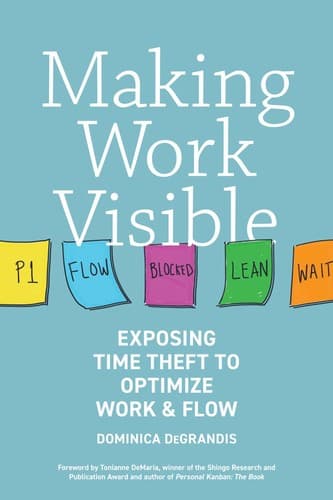
Dominica DeGrandis · 2017 · read this one first
Making Work Visible is the one to read first, because it answers the question most teams are actually asking: why is everybody busy and nothing finished? DeGrandis names five thieves of time, too much work in progress, unknown dependencies, unplanned work, conflicting priorities and neglected work, and shows each one on a board rather than in an argument. The fix is unglamorous and it works: put every piece of work where people can see it, then cap how much is allowed to be in flight at once.
Read it if your team finishes little despite long days, which is a flow problem and not a motivation problem. Skip it if you want leadership philosophy: this is operational, closer to a manual than an argument, and that is the highest compliment on this page.
Patrick Lencioni · 2012 · when smart people pull apart
The Advantage is the best explanation of why a company full of capable people executes badly, and the cause it names is clarity rather than skill. Lencioni argues the leadership group has to answer six questions identically, why we exist, how we behave, what we do, how we will succeed, what is most important right now, and who does what, and then repeat the answers long past the point where saying them again feels embarrassing. It is his one non-fiction book and it consolidates the fables that made him famous.
Read it if two people in your company would give a client two different answers about this quarter’s priority. Skip the earlier fables if you read this: it contains their arguments without the stories, which is a fair trade in either direction.

Matt Mochary · 2019 · the most copyable book here
The Great CEO Within is the most directly copyable book on this list, because it is an operating manual rather than an argument. Short chapters cover the meeting cadence, how goals get set and reviewed, how feedback is given, how to hire, and what a founder should stop doing personally, each written as instructions you can adopt one at a time without buying the rest. It reads like a coach’s working notes, which is exactly why it transfers to a company of twelve.
Read it if you are the founder and the company’s operating rhythm is whatever you remembered to schedule this week. Skip it if you want evidence: this is one experienced coach’s practice presented as instruction, and it says so.
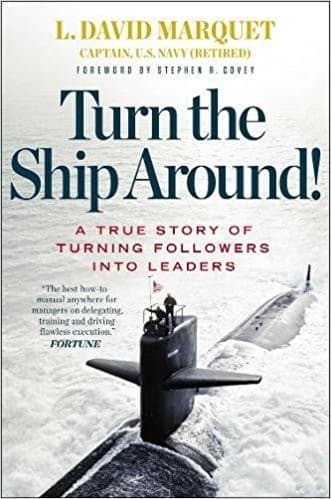
L. David Marquet · 2012 · when every decision waits for you
Turn the Ship Around! is the practical answer to a founder who has become the bottleneck for every decision, and it arrives from an unlikely place, a nuclear submarine. Marquet’s change was almost entirely linguistic: instead of asking permission, people said “I intend to…” and gave their reasoning, which moved the decision to whoever had the information and left the leader with one job, saying no when the reasoning was wrong. One idea, told as a story, and the idea is worth the book.
Read it if your team waits for you and you have started to resent being waited for. Skip it if you want a system: it is a single move, and the honest caveat is that a submarine crew is not a twelve person agency, so what transfers is the sentence people use, not the hierarchy around it.
Four that explain why the work does not move
These four are diagnosis, and each names a different cause: a single constraint that sets the pace, the distance between knowing and doing, the owner’s own calendar, and the leadership work that cannot be handed off. Three of them are worth the time. We have included the fourth because it is on every list and somebody should say plainly what it is like to read at your size.
Eliyahu Goldratt and Jeff Cox · 1984 · the model under the rest
The Goal is the mental model sitting underneath half of this page, delivered as a novel about a failing factory. The claim is narrow and hard to unlearn: the output of any system is set by a single constraint, so effort spent anywhere else changes the numbers on a report and nothing in reality. Once you have read it, the phrase “we are all working flat out” stops sounding like a defense and starts sounding like a description of the problem.
Read it if you like an argument you can follow as a story, and if you want the origin of bottleneck thinking rather than its summary. Skip it if machinery and inventory put you off, because the same reasoning reaches you secondhand through Making Work Visible and The Phoenix Project.
Atul Gawande · 2009 · knowing is not the same as doing
The Checklist Manifesto is the clearest book here on the gap between knowing what to do and doing it reliably, and it gets there through surgery and aviation rather than business. Gawande separates failures of ignorance, where nobody knew, from failures of ineptitude, where the knowledge existed and was not applied, and argues almost all modern failure is the second kind. His conclusion reframes something small teams treat as bureaucracy: a checklist is not a process document, it is a defense against a competent person’s memory on a bad day.
Read it if your team has made the same avoidable mistake twice and the response so far has been to ask people to be more careful. Skip it if you want the case compressed: the argument is short and it is made through two hundred pages of stories.
Peter Drucker · 1967 · when you are the constraint
The Effective Executive is the oldest book on this list and the only one about the thing no framework repairs: where your own hours actually go. Drucker treats effectiveness as a set of habits rather than a talent, and the habits have not aged: record where your time really goes before trying to manage it, ask what contribution is required rather than what work is available, staff for strengths instead of the absence of weakness, do first things first and genuinely refuse the rest, and decide about the recurring problem instead of the incident in front of you.
Read it if you are the constraint, which in a company under twenty people is the most likely answer and the least welcome one. Skip it if you need examples from this decade: the reasoning holds up completely and the illustrations are from a world of secretaries and telegrams.
Larry Bossidy and Ram Charan · 2002 · the famous one, and the least usable
Execution has the word in its title, sits on every recommended list, and is the least usable book here at your size. Its central claim is right and worth carrying: execution is the leader’s own work rather than something delegated downward after the strategy is announced. The machinery it proposes to deliver that, three linked processes for people, strategy and operations, assumes divisions, a succession plan and an HR function, and it was written by a Honeywell chief executive and a corporate advisor for readers who had all three.
Read it if you manage managers, or if you want the vocabulary other people are using when they say the word. Skip it at twelve people: nearly everything in it needs translating before it applies, and the four books in the group above already say what survives the translation.
Find Execution The Discipline of Getting Things Done on Amazon →
If you would rather be taught than read, this ground is lesson 12 of 17 in From Zero to Goals: The week-six crisis. Choose between cutting scope, swapping a key result, pushing, and killing a goal, and know which one you’re doing. You make the calls inside one realistic company, run the exercise on your own goals, and the course ends with a 15 question exam (12 to pass) and a certificate worth putting on your profile.
Two more worth knowing, and two we reviewed elsewhere
Two more are worth knowing if your work is software. Accelerate by Nicole Forsgren, Jez Humble and Gene Kim, from 2018, is the only book on this subject with real evidence behind it rather than case studies chosen after the fact, and it identifies four measures of delivery performance that predict the rest. The caveat matters: it is about shipping software, so if you do not, the method of measuring transfers and the four measures do not. The Phoenix Project, from 2013, is The Goal retold inside an IT department, and it is the easiest way into both.
Two books you would expect here are reviewed on a different page. The 4 Disciplines of Execution and Traction are genuinely execution books, and both are also the books most often mistaken for OKR guidance, so we covered them where that confusion does damage: in our eight best OKR books, with a warning about running two frameworks at once.
One book we leave off deliberately is Getting Things Done. It is a good system and it is about one person’s inbox: nothing in it helps three people agree which of this quarter’s commitments to drop. Personal productivity and team execution fail for different reasons, and treating the first as a cure for the second is how a company ends up with five well organized people and one missed quarter.
Which one to read first
Which book to read first depends on the symptom, not on which book is best. Four situations cover almost every team that lands on this page.
Everyone is busy and nothing finishes: Making Work Visible
Put every piece of work on one visible board and cap how many things are allowed to be in progress. Do that before changing anything else, because a lower limit usually reveals which of the other problems you actually have.
Two people give clients two different answers: The Advantage
Answer the six questions with your leadership group in one sitting, write them down, and then repeat them until it feels excessive. The repetition is the intervention, not the writing.
Every decision waits for you: Turn the Ship Around!
Change the sentence your team uses from asking permission to stating intent, then sit with the first three decisions you would have made differently. That discomfort is the whole cost of the method.
The same avoidable mistake, twice: The Checklist Manifesto
Write a five line checklist for the single moment where it goes wrong, not for the whole process. Checklists that try to cover everything are the reason people believe checklists do not work.
What none of these books will tell you
None of these books will tell you how much to attempt in one quarter at your size, and that is the decision execution actually turns on. The honest answer for a team of ten to fifty is smaller than anybody likes: one company objective, one objective per area, and a single named owner for every measurable result, which usually means saying no to two things that were already promised. Every book here would endorse that number and not one of them states it, because at Honeywell or in a hospital system the question never arrives in that form.
The second gap is that all eight assume somebody whose job is to run the rhythm. In a company of twelve that person is the founder, doing it between client calls, so any method that needs more than about thirty minutes a week and one screen everyone can see will quietly stop happening in month two. That is not a failure of discipline. It is a design constraint, and a method that ignores it was written for a different company.
Reading eight books is one way to learn this. The shorter version is a weekly rhythm you do not have to remember: in Celorly the quarter’s objectives sit under the strategy that justifies them, each measurable result has one named owner, the check-in shows what is on track and what is behind without anybody assembling a report, and the quarter ends on a scoring screen rather than in silence. The course linked above runs that rhythm inside a fictional twelve person agency for a full year, week six crisis included.
Where to go next
Where to go next depends on whether the problem is the rhythm or what the rhythm is pointed at. If it is the rhythm, how to track goals covers the loop without the busywork, our goal check-in template is the weekly cadence these books argue for in copy-paste form, and how to run a goal review meeting is the close-out that stops a quarter from being abandoned rather than finished. If the problem is that the moving work is not the work you would have chosen, that is upstream: our eight best strategy books cover choosing, our eight best goal setting books cover the goal itself, including four that argue companies should set them differently, and quarterly planning for small teams is the session where a choice becomes three months of work.
What is the best book on execution?+
Making Work Visible by Dominica DeGrandis, from 2017, for most small teams. It treats the common complaint, everybody busy and nothing finished, as a flow problem rather than a motivation problem, and its fix is something you can do this week: put all the work where people can see it and limit how much is in progress at once. The Advantage is the better first book if your problem is that people disagree about the priority rather than drowning in it.
My team is busy but nothing gets finished. What should I read?+
Making Work Visible, and then act on one idea from it: cap the number of things in progress. DeGrandis names five thieves of time, and the biggest in small teams is simply too much started at once, because every extra item in flight adds handoffs, waiting and context switching that nobody counts as work. The cap feels wrong for about two weeks and then throughput goes up.
Is Execution by Bossidy and Charan worth reading?+
Only if you manage managers. Its main claim is correct, that execution is the leader’s own work rather than something handed down after the strategy is announced, but the apparatus around it assumes divisions, a succession plan and an HR function. At twelve people almost every chapter needs translating before it applies, and the practical books on this page already say what survives that translation.
Is The 4 Disciplines of Execution an execution book?+
Yes, and a good one, but we review it on our OKR books page instead. The reason is that it is the book most often mistaken for OKR guidance, and a team that reads it that way ends up running two frameworks at once, using the vocabulary of both and the discipline of neither. The same applies to Traction, which is reviewed there too.
What is the difference between a strategy book and an execution book?+
A strategy book helps you decide what to pursue and what to give up. An execution book helps whatever you chose actually move. The failure modes are different: bad strategy means the team delivers the wrong thing efficiently, and bad execution means the right choice sits in a document while everyone stays busy. Reading the second kind will not rescue you from the first.
How many execution books do I actually need to read?+
One, and only until it changes something. The useful test is whether a book has altered your calendar or your work-in-progress limit within two weeks of finishing it. If it has not, another book on the same subject will not either, and the problem is not that you are missing an idea.