Four of the books below are about OKRs and four are not, and the second group is the reason most reading lists mislead people. If you read one, read Radical Focus by Christina Wodtke, because it is the only one that covers the weeks between writing the goals and scoring them. Each book here comes with who should read it, who should skip it, and what it gets wrong.
How we picked these eight
We picked these eight on four criteria: the book has to explain the practice rather than the idea, admit where the method fails, survive being applied by a team of about twelve, and be worth opening a second time. Those criteria are also why the list is split in two rather than presented as eight interchangeable OKR books.
It explains the practice, not the idea
The idea behind OKRs fits on a napkin: an objective plus a few measurable results. A book earns its place by covering what happens in weeks two through eleven, which is where every quarter is actually won or lost.
It admits where the method fails
Books that treat OKRs as a solution to every problem are marketing. Every book here names a failure mode, from goals nobody can score to teams that quietly keep two sets of priorities.
It survives contact with a small team
Most writing on this subject assumes departments, program managers and a quarterly business review. Each book below is judged on what is left when you have twelve people and no operations function.
You would open it again in week six
Books you read once and shelve are entertainment. The test is whether a chapter is worth returning to on the Monday when a key result is stuck at 0.2 and nobody wants to say so.
Four books about OKRs
These four take the method as their subject. Between them they cover the history, the sentence, the scoring and the rollout, and only one of them covers the middle of the quarter, which is the part that decides whether any of it works.
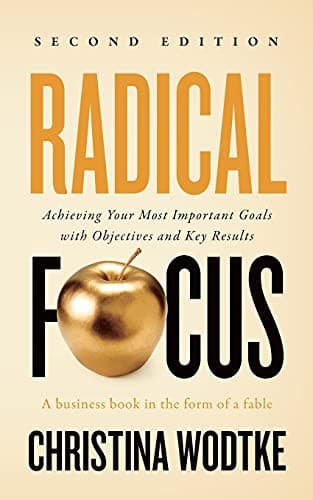
Christina Wodtke · second edition 2021 · the one to read first
Radical Focus is the one to read first, because it is the only book here that treats the quarter as a rhythm rather than a document: Monday commitments, Friday wins, and a confidence score somebody has to say out loud. Half of it is a fable about a two-person startup running out of money, and half is the commentary explaining what the founders got wrong.
Read it if you are about to run your first quarter, or your last one drifted after week three. Skip it if you want data and benchmarks: it is deliberately a story, though the commentary chapters stand alone.
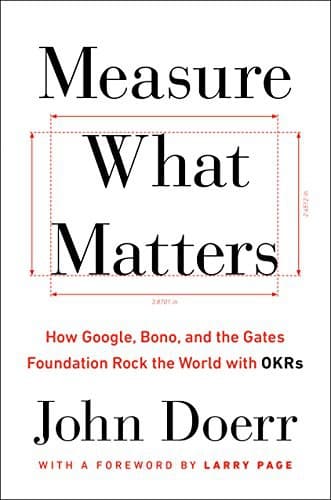
John Doerr · 2018 · best for getting buy-in
Measure What Matters is the best book here for convincing somebody and the thinnest for running a quarter. Doerr learned the method from Andy Grove at Intel, brought it to Google, and built the book from case studies including Google, the Gates Foundation and Bono’s ONE campaign. The examples come from organizations with thousands of people, so the mechanics that matter at twelve arrive as anecdote rather than instruction.
Read it if somebody whose agreement you need is not convinced. Skip it if the decision is already made: you will finish it inspired and still unsure what to do on the first Monday.
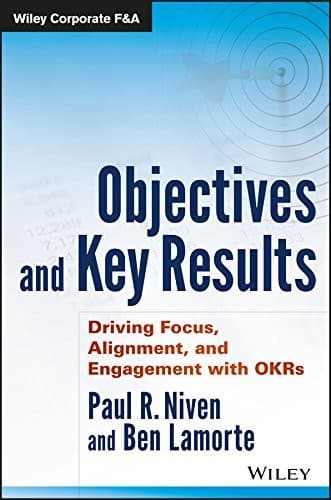
Paul Niven and Ben Lamorte · 2016 · the reference
Objectives and Key Results is the reference on this list: the book you open with a specific problem, not the one you read through. It is the most complete treatment of the parts other books wave at, including how to score results that are binary rather than gradual, in what order to roll the method out, and how to keep a scoring scale from turning into a performance rating.
Read it if you are the person others ask when a scoring question comes up. Skip it if you are looking for momentum: it gives you rigor, and rigor is not what gets a first quarter started.
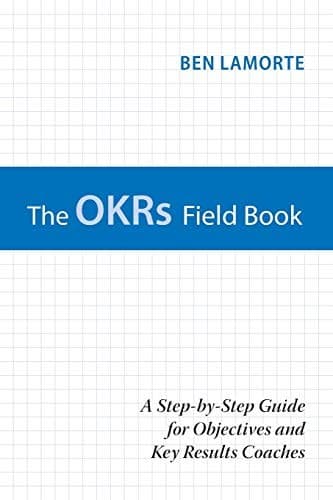
Ben Lamorte · 2021 · written for whoever runs the rollout
The OKRs Field Book is the only one written for the person doing the implementing rather than the person being convinced. Lamorte has coached the method into a lot of companies, and the book is structured as the sequence he uses: who to involve, what to write first, which meetings to add, and what to do in the quarter when it starts to slide. It reads like notes from a practitioner, which is both its strength and the reason it is not the one to start with.
Read it if you are the one who has to make this work for other people. Skip it if you are a team of five, because a good half of it addresses problems that appear only with several layers of management.
Four books that are not about OKRs, and make them work anyway
Every one of these appears on lists of OKR books, and none of them is about OKRs. That matters more than it sounds: two of them describe competing systems with their own vocabulary, and a team that reads them as OKR guidance ends up running two frameworks at once, using the words of both and the discipline of neither.
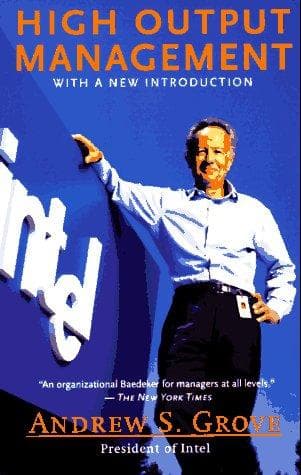
Andrew Grove · 1983 · where the method came from
High Output Management is not an OKR book, and that is exactly why it is here. Written by the man who ran the method at Intel, it is a management book about output, meetings, training and the leverage a manager has, in which goal setting occupies one chapter. That chapter explains what the modern books assume: OKRs were never meant to be the system, only one instrument for a manager who had several.
Read it when the method starts to feel like paperwork, usually in the second or third quarter. Skip it if you want current examples: it is from 1983 and you do the translation yourself.
McChesney, Covey and Huling · 2012 · a competing system
The 4 Disciplines of Execution is a different system with its own vocabulary: one wildly important goal, lead and lag measures, a visible scoreboard, and a weekly meeting where people commit. It is genuinely good, and it is the book most often mistaken for an OKR book. Read it as a contrast and you learn something; read it as OKR guidance and your team ends up running two frameworks at once, using the words of both and the discipline of neither.
Read it if your problem is that nothing gets finished, because it is better than any OKR book on the weekly commitment. Skip it if you have just adopted OKRs and the team is still learning the vocabulary.
Gino Wickman · 2007 · quarterly priorities, other name
Traction describes EOS, an operating system for owner-run companies in which quarterly priorities are called Rocks. It is popular for a good reason: it is concrete, and it covers the meetings, the scorecard and the accountability chart, not just the goals. The honest warning is that it is a whole system with opinions about how your company is organized. Adopt it, or take the quarterly rhythm from it, but do not blend its vocabulary into OKRs and hope.
Read it if you own the company and want one book covering the whole operating rhythm. Skip it if you only wanted the goals part, because four fifths of it is about everything else.
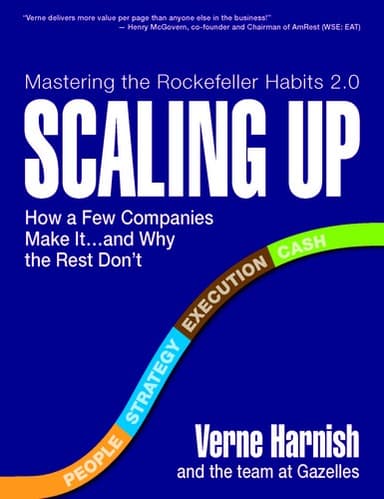
Verne Harnish · 2014 · the planning end of the same problem
Scaling Up is the planning half of what OKRs do, written for companies going from small to medium. Its one-page plan and quarterly priorities are close cousins of an objective with key results, and the chapters on cash and on people are the parts no OKR book touches. It is the most corporate book on this list, and a fifteen-person company will skip a third of it.
Read it if you are planning a year rather than a quarter, and want the money and hiring questions in the same frame as the goals. Skip it if you are pre-revenue: much of it assumes a company with a payroll to protect.
If you would rather be taught than read, this ground is lesson 5 of 17 in From Zero to Goals: A goal you’re allowed to miss (OKR). Tell a commitment from a stretch goal, and know why scoring 0.7 can be a success. You make the calls inside one realistic company, run the exercise on your own goals, and the course ends with a 15 question exam (12 to pass) and a certificate worth putting on your profile.
Two newer books worth knowing
Two newer books are worth knowing, and both are too recent to have settled into the usual lists. Who Does What By How Much? by Jeff Gothelf and Josh Seiden, from 2024, is the most customer-centric take on writing key results, and the shortest useful thing on the subject. Outcomes Over Output by Josh Seiden, from 2019, is not about OKRs at all and fixes the single most common mistake in them: writing a key result that counts what you shipped instead of what changed for somebody.
One book we deliberately leave off every version of this list is Atomic Habits. It is excellent, it is about personal behavior change, and nothing in it helps three people agree on one number for the quarter.
Also off this list, and reviewed separately, are the books about choosing the direction the OKRs are supposed to serve. Those are in our eight best strategy books, which covers Rumelt, Porter and the book the BHAG actually comes from. Two books reviewed above, The 4 Disciplines of Execution and Traction, also belong on a third shelf: they are execution books, and the rest of that shelf is in our eight best execution books.
Which one to read first
The order depends on what is blocking you, not on which book is best. Four situations cover almost everyone.
Starting your first quarter: Radical Focus, second half first
The commentary is the part you need. If the quarter starts next week, read the chapters on the weekly cadence and come back for the fable later.
Somebody needs convincing: Measure What Matters
If the decision is already made this book will not change your Monday. If a co-founder is unconvinced, the case studies do that work better than you will in a meeting.
A specific problem, usually scoring: Niven and Lamorte
Reach for it when you hit the question rather than before. Reading it cover to cover is a slog with a low return; the chapters on scoring and rollout are worth their weight.
It has started to feel like paperwork: Grove
Somewhere in the second or third quarter the method turns into admin. Grove is the antidote, because he treats goals as one instrument in a manager’s hands rather than as the point of the exercise.
What none of these books will tell you
None of these books will tell you how to size the method to a team of nine, because all eight were written with a bigger company in mind. None answers the question a nine-person team asks in the first ten minutes: how many objectives is too many when there are only nine of us, and who owns a key result when one person does three jobs. The honest answer, one company objective and one per area with a single named owner for every key result, is not in any of them, because at Intel and Google that question never came up.
The second gap is scoring. Every book agrees that 0.7 is a good score and none explains what to say to the person who delivered 0.4 on a goal that turned out to be impossible. That conversation is the whole method working or failing, and it happens in week eleven, long after the book is back on the shelf.
Reading eight books is one way to learn this. Running one quarter with the mechanics already in place is faster, and it is what Celorly is: direction at the top, objectives with measurable key results under them, a check-in that shows what is on track and what is behind, and a scoring screen at the end so the quarter is settled rather than abandoned. The course linked above is the third route: the same quarter, run inside a fictional twelve-person agency, with the decisions in your hands.
Where to go next
Where to go next depends on whether you would rather start than read. Four of our guides cover the same ground at the size of a small team. Begin with OKRs explained for the method end to end, then how to write OKRs for the sentence itself. When the quarter closes, OKR grading and scoring covers the part the books hand off, and common OKR mistakes is the shortcut through the failures all eight authors describe.
What is the best book on OKRs?+
Radical Focus by Christina Wodtke. It is the only widely read OKR book that covers the middle of the quarter, which is where the method usually fails: the weekly commitment, the confidence score, and what to say when a key result is stuck. Measure What Matters is better known and better at persuasion, but it will not tell you what to do on the first Monday.
How many books do I need to read to run OKRs?+
One, and only if you like reading. The idea takes a paragraph: one objective people can repeat, two or three results you can measure, and a weekly check-in that is honest. Books help most in the second quarter, when the first one has drifted and you want to know whether the problem is the method or the way you ran it.
Is Measure What Matters worth reading?+
Yes, for one job: convincing somebody. John Doerr’s case studies from Intel, Google and the Gates Foundation make the method feel inevitable, and that is useful when a co-founder is unconvinced. If the decision is already made, the mechanics you need are thinner here than in any other book on this list.
Is The 4 Disciplines of Execution an OKR book?+
No. It describes a separate system with its own vocabulary: one wildly important goal, lead and lag measures, and a scoreboard. It is a good book and a bad substitute, because mixing its language with OKRs is how a team ends up running two frameworks at once and finishing neither.
Are there any OKR books written for small teams?+
Not really, and it is the main gap in the literature. All eight books here assume more people and more process than a team of ten to fifty has, so the adaptations that matter most, one company objective, one per area, a single named owner per key result, are left to the reader.